Tree Guide
Avocado Plant Growth Time: Seed to Fruiting Tree
Germination in weeks, structure in years, fruit later still. This is the realistic avocado growth timeline, with the four growing situations that change it.
4 min read
Broad, dense and evergreen, with a canopy that often reaches the ground. Here is what a mature avocado tree actually looks like, and why no single height fits them all.
The short answer
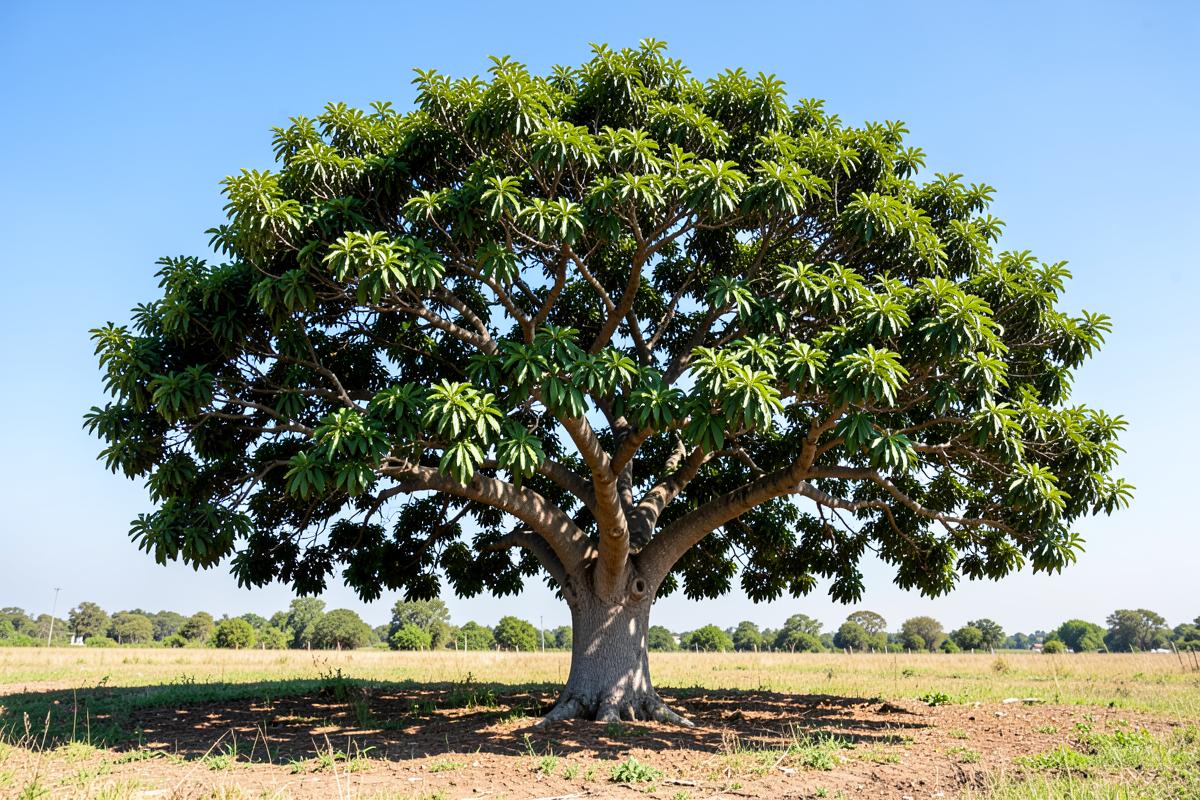
A fully grown avocado is a broad evergreen tree with a dense, rounded, often low-branching canopy and large glossy leaves. Unpruned in the ground it commonly reaches somewhere between 8 and 15 metres, while pruned garden trees are usually kept to 3–5 metres and container trees to 2–3 metres. There is no single mature height, because variety, rootstock, climate and pruning all change it.
A note on terminology first, since the search phrasing varies: people often say “avocado plant” for a seedling on a windowsill and “avocado tree” once it has a woody trunk and a canopy. Botanically it is the same species throughout — Persea americana — and it is properly called a tree once mature.
Mature avocados are dense and spreading rather than tall and narrow. Many varieties branch low, so the canopy sweeps close to the ground unless it has been lifted by pruning. The overall silhouette is a broad dome, evergreen year-round, with a heavy shade cast beneath it. Older leaves drop continuously rather than all at once, so there is usually a thick leaf litter under the canopy — which is exactly what the tree's shallow roots want.
The trunk of an old tree is thick and grey-brown, often with rough, slightly fissured bark, and frequently divides into several main limbs quite low down. Wood is comparatively brittle, so heavily laden branches can split — one practical reason orchards prune to keep trees compact and well structured.
Avocado flowers are small, pale greenish-yellow and produced in enormous numbers on branched panicles at the ends of shoots. A large tree may open in the order of a million flowers in a season and hold only a few hundred fruit — extreme flower drop is normal, not a fault. Each flower opens twice, once in a functionally female phase and once as male, which is the basis of the Type A and Type B classification.
Fruit hangs singly or in small clusters on slender stalks and can take many months to reach maturity. Skin may be thin and smooth green, or thick, dark and pebbled, depending entirely on variety. Distinctively, avocados do not soften on the tree; they hold and ripen only after picking, which is why a mature tree can carry fruit for a long window.
This is the part people never see and most often damage. Avocado roots are shallow and wide-spreading, with the bulk of feeding roots in the top layer of soil, and they have very few root hairs. Practically: keep mulch over the root zone, do not dig beneath the canopy, and never compact the soil around a mature tree.
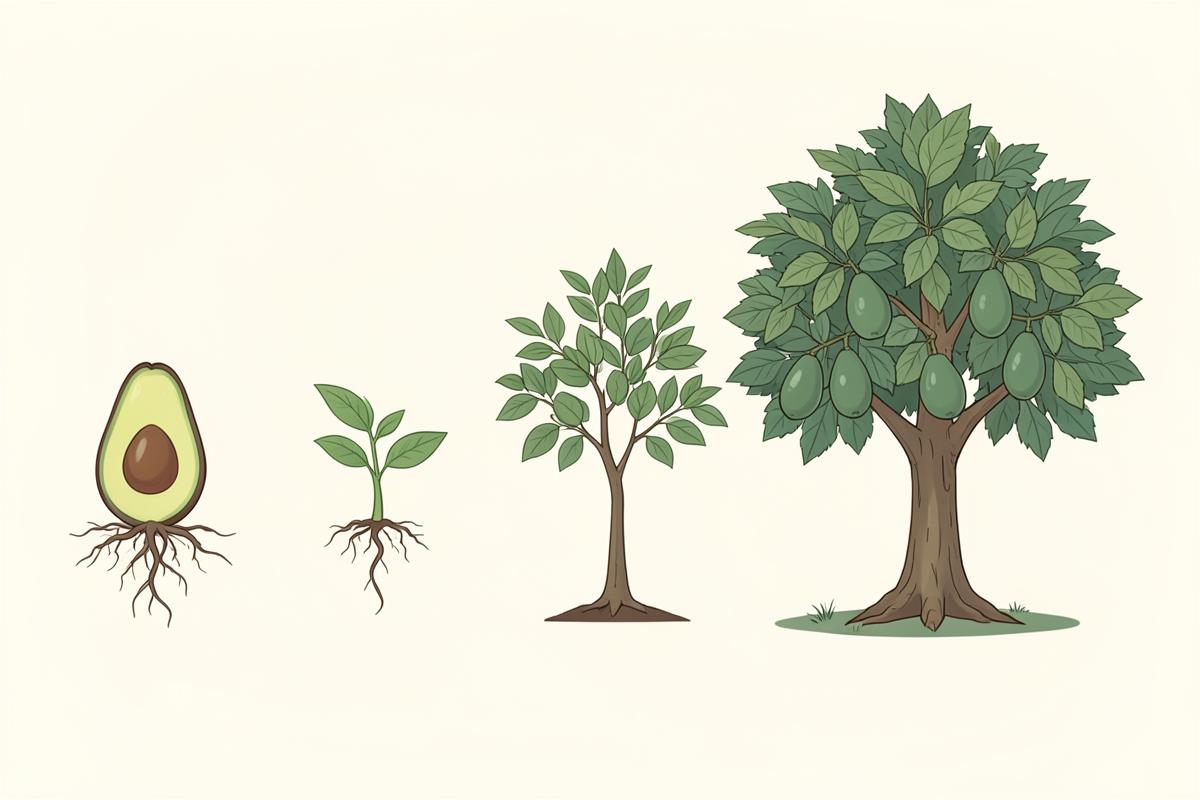
| Stage | Appearance |
|---|---|
| Seedling | A single soft green stem with a few large leaves clustered at the top |
| Young tree | Woody at the base, first branches forming, canopy still open and thin |
| Established tree | Defined trunk and framework limbs, dense canopy, first flowering |
| Mature tree | Broad dome, thick grey trunk, deep shade beneath, regular flowering and fruiting |
Seedling
Young tree
Established tree
Mature tree
The corresponding timings are set out in Avocado Plant Growth Time, and the two milestone stages people ask about most are covered in 1 year old and 5 year old guides.
| Container | In the ground | |
|---|---|---|
| Typical mature height | 2–3 m | 8–15 m unpruned; 3–5 m if managed |
| Canopy | Compact, easily reached | Broad, often touching the ground |
| Trunk | Slim | Thick, sometimes multi-stemmed |
| Crop | Modest | Substantial in suitable climates |
| Dependence on you | Total — water, feed, root space | Lower once established |
Typical mature height
Canopy
Trunk
Crop
Dependence on you
A grafted tree carries a visible union — a swelling or diagonal scar low on the trunk — and often has a slightly different bark texture above and below it. Seed-grown trees have a single uninterrupted stem and tend to be taller and more upright, at least when young. Beyond that, appearance is mostly a matter of variety and pruning.
Unpruned in the ground, commonly 8–15 metres. Managed garden trees are usually kept to 3–5 metres and container trees to about 2–3 metres. Variety, rootstock, climate and pruning all change the figure.
Both refer to the same species. “Plant” is generally used for young seedlings and “tree” once it has a woody trunk and canopy — which is the correct term for a mature specimen.
Well-cared-for trees remain productive for decades, and individual trees can live far longer. Productive life in orchards is usually shorter than biological life.
They are evergreen and shed older leaves gradually through the year rather than all at once. Heavy sudden leaf drop signals cold damage, drought or root problems.
Small, pale greenish-yellow and carried in large branched clusters at branch tips. A single tree can open an extraordinary number of them and keep only a tiny fraction as fruit.
Horticultural and nutritional claims on this page are drawn from these references.
We write from two places: published horticultural research from institutions such as ICAR-IIHR and the University of California, and what our partner farms actually observe growing avocado in Indian conditions. Where the evidence is thin or regional, we say so instead of rounding it into a confident answer.
Researched and written in-house, reviewed by our farm coordination team. Last reviewed 4 September 2026.
Our Knowledge Hub covers growing, care, varieties, grafting and fruiting in one place — and if you would rather start with an established tree, we can tell you honestly whether one will do well where you live.
Free calculators that turn this guide into a result for your own conditions.
Score your light, soil, drainage and watering, and see what to change first.
Estimate when your tree may flower and set fruit — and what is holding it back.
See where your tree sits on the growth timeline and what comes next.
Tree Guide
Germination in weeks, structure in years, fruit later still. This is the realistic avocado growth timeline, with the four growing situations that change it.
4 min read
Tree Guide
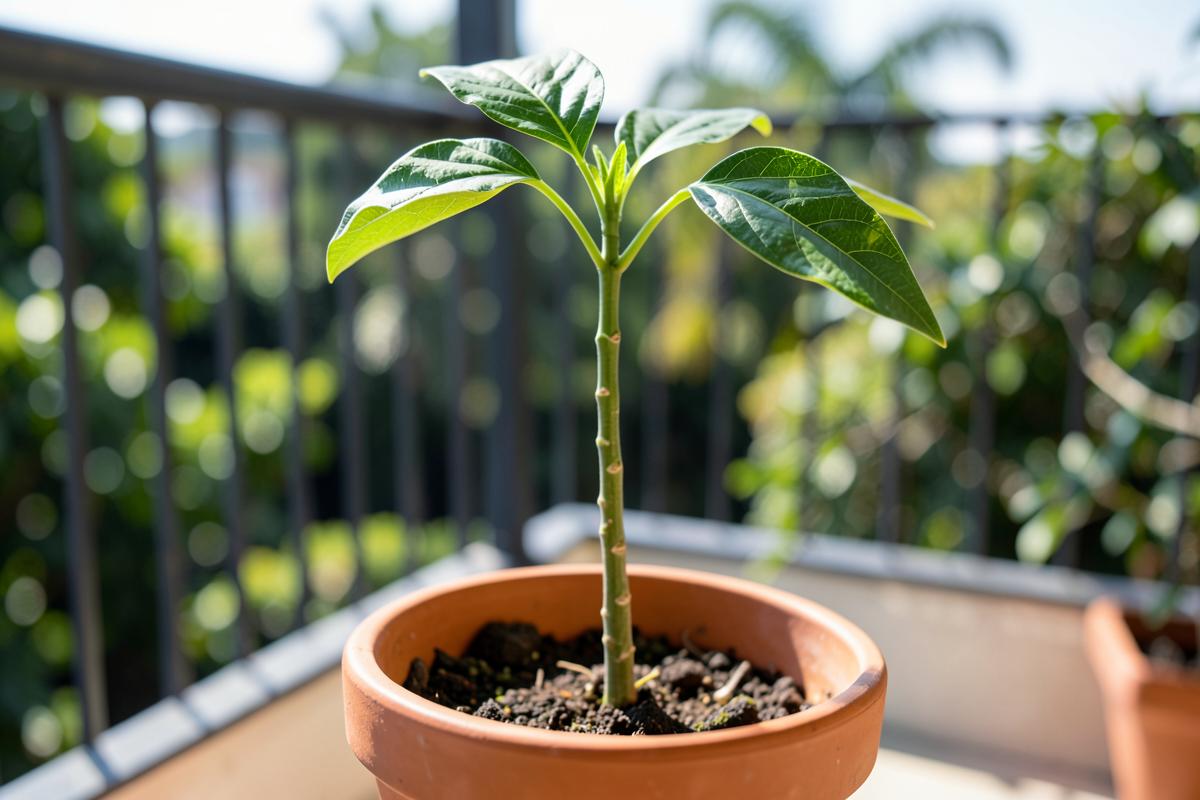
One year in, a seed-grown avocado is usually a single leggy stem with a handful of large leaves. Here is what is normal, what is a warning sign, and what to do next.
6 min read
Tree Guide
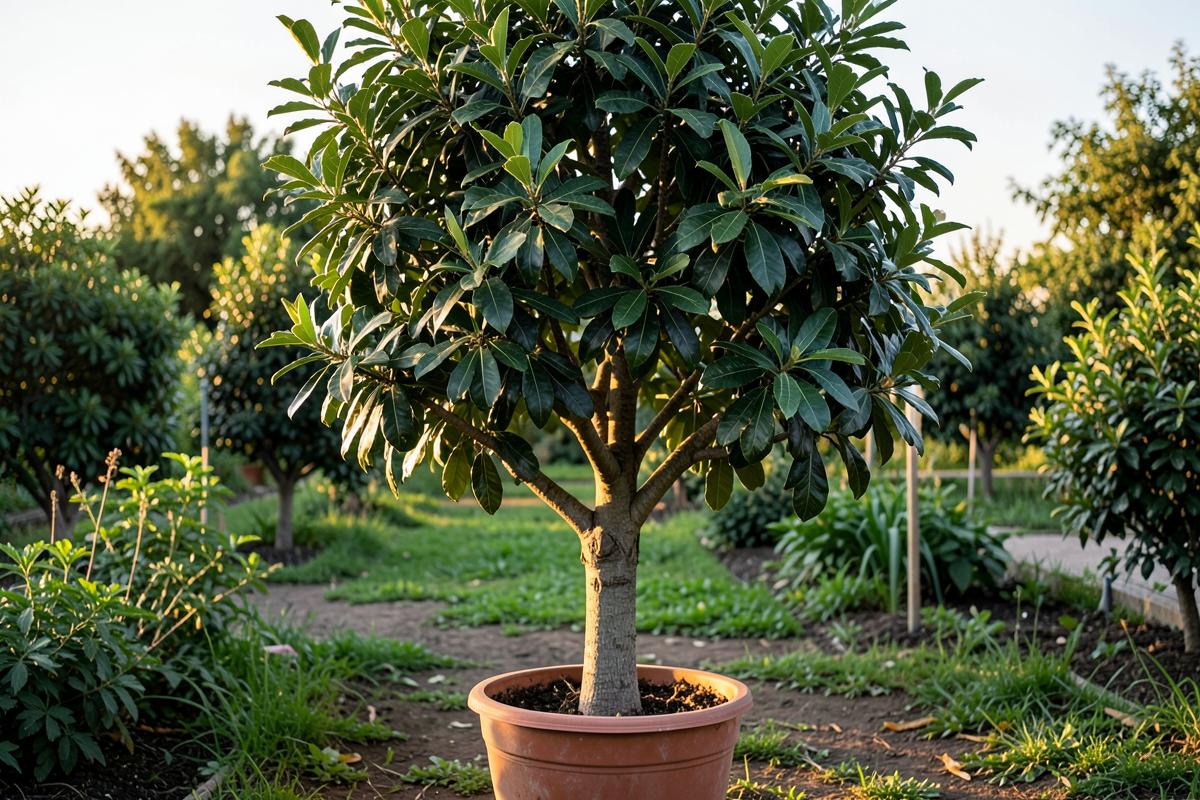
Five years in, a seedling is a real tree — trunk, canopy, appetite for water. Whether it fruits is a different question, and this guide answers it plainly.
5 min read
Tree Guide
Left alone, an avocado becomes a genuinely large shade tree. In a container under pruning it stays manageable. The gap between those two outcomes is the whole planning question.
4 min read