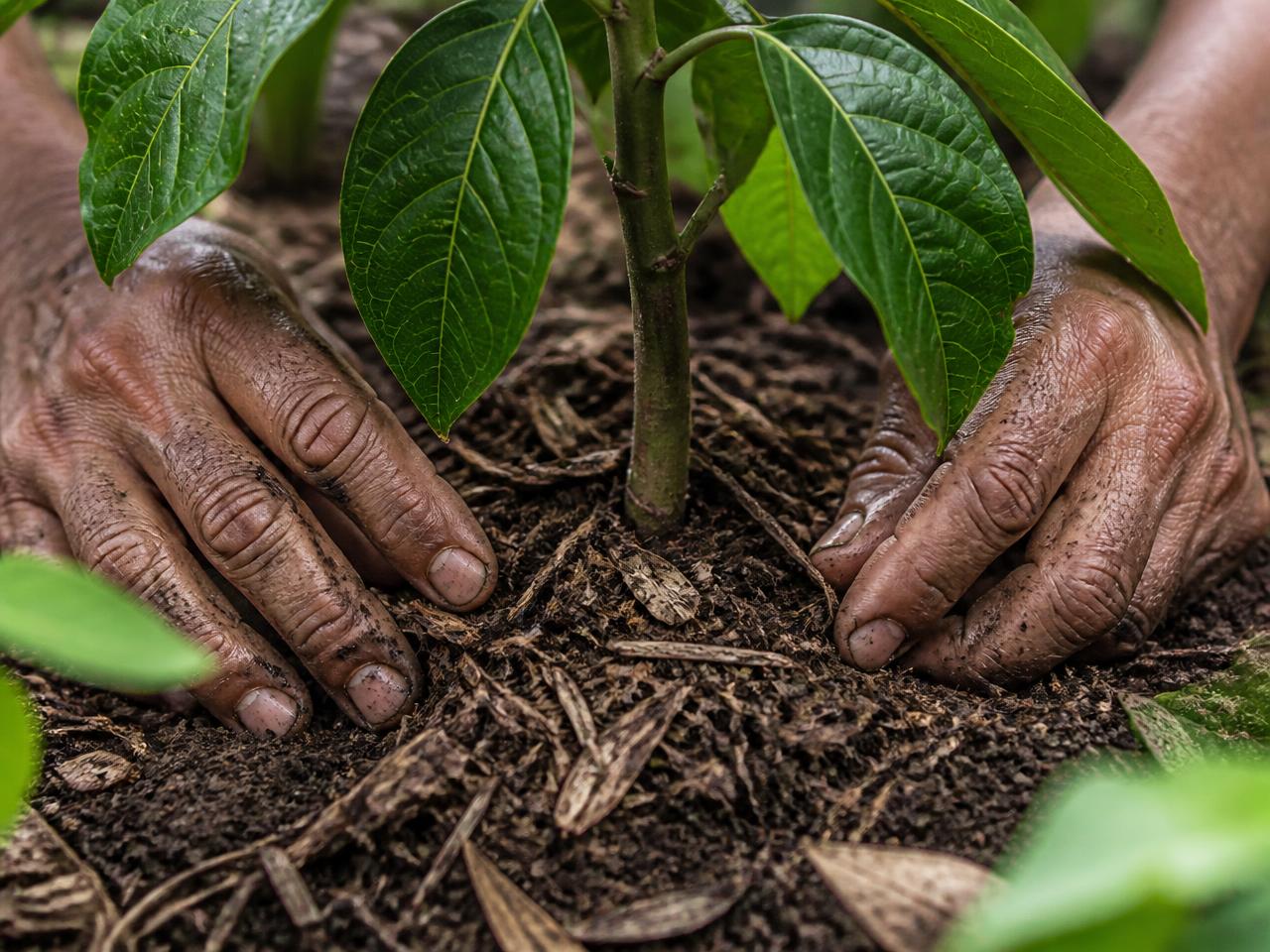
Care
Why Are Avocado Tree Leaves Turning Brown?
Where the browning starts tells you the cause. Tips and margins point to salt; whole-leaf browning points elsewhere entirely.
3 min read
Most avocado problems come from four causes: water at the roots, salt, temperature stress, or a tree that is simply too young. Start here and narrow down.
Avocado problems look alike and have opposite fixes, which is why so many trees are killed by well-intentioned care. Work through the diagnosis before you act.
The single most useful diagnostic
Wet soil plus a wilting tree is a root problem. Dry soil plus a wilting tree is thirst. Those two situations look identical from above and require opposite responses.
| Symptom | Most likely causes | First action |
|---|---|---|
| Brown, crispy leaf tips | Salt accumulation from irrigation water or fertiliser; underwatering | Flush the container heavily with clean water; review water quality and feeding |
| Yellowing leaves, generally | Overwatering or root rot; nutrient leaching in containers; iron chlorosis | Check soil moisture and drainage before adding anything |
| Yellow leaves with green veins | Iron chlorosis — often a soil pH or waterlogging issue rather than a lack of iron | Correct drainage first; consider soil pH |
| Sudden heavy leaf drop | Transplant shock; acute heat or cold; root damage | Stabilise conditions; do not fertilise or repot into stress |
| Wilting in wet soil | Root rot — the serious one | Improve drainage immediately. Stop watering. Get advice |
| Wilting in dry soil | Simple drought stress | Water deeply and thoroughly, then review your routine |
| Stalled growth | Insufficient light; root restriction; cold; recovery from stress | Check hours of direct sun first, then the root zone |
| Scorched patches on leaves | Sunburn on a tree moved abruptly into full exposure | Reintroduce to full sun gradually; shade the pot |
| No fruit on a mature tree | Too young; stress during flowering; alternate bearing | Usually patience — see the dedicated guide |
Brown, crispy leaf tips
Yellowing leaves, generally
Yellow leaves with green veins
Sudden heavy leaf drop
Wilting in wet soil
Wilting in dry soil
Stalled growth
Scorched patches on leaves
No fruit on a mature tree
UC IPM identifies Phytophthora cinnamomi root rot as the most serious disease of avocado. It attacks the small feeder roots, so the tree loses its ability to take up water even while sitting in it — which is why the symptoms mimic drought.
Signs pointing to root rot
Prevention is essentially the whole treatment
Once root rot is established in a home tree it is difficult to reverse. Free drainage, no standing water, and never planting into a spot that holds water are the real controls.
Avocado is unusually sensitive to salinity, and salts concentrate in a container's root zone as water evaporates. The classic sign is browning that starts precisely at the leaf tip and works inward along the margin, on otherwise healthy-looking foliage.
UC ANR notes that avocado groves see relatively few mineral deficiencies, partly because efficient shallow feeder roots recycle nutrients from decomposing leaf litter. The standard programme is nitrogen annually, zinc occasionally, and others only sometimes. Calcium is noted as potentially useful on acid soils and may confer some root-rot resistance.
Containers are different. Regular watering leaches nutrients steadily, so potted trees genuinely need feeding — modestly, during growth flushes, never into heat or drought stress.
Avocado tolerates pruning well. Remove dead, damaged and crossing wood; open the centre so light and air reach inside the canopy; maintain a working height you can reach. Do it outside extreme heat and cold, and never cut below the graft union.
If a tree is declining and you are not sure why, adding treatments is more likely to compound the problem than fix it. Send a photo of the whole tree, a close-up of the affected leaves, and the soil surface — that is usually enough to narrow it down.
For rented trees, this diagnosis is part of the service, not an extra.
In most home cases, the root zone. Waterlogging and Phytophthora root rot are the leading causes, followed by salt accumulation, acute heat or cold, and prolonged drought. Check soil moisture and drainage before doing anything else.
Only if the soil is dry. If the soil is wet and the tree is wilting, that is a root problem and more water will accelerate it. Improve drainage instead.
Brown, crispy tips usually indicate salt accumulation. Flush the container thoroughly with clean water so salts leach out, review your irrigation water quality, and reduce fertiliser.
In the ground, avocado is not a heavy feeder — nitrogen annually with occasional zinc is the standard programme. Container trees need more, because watering leaches nutrients, but feed modestly during growth flushes rather than heavily at once.
Horticultural and nutritional claims on this page are drawn from these references.
We write from two places: published horticultural research from institutions such as ICAR-IIHR and the University of California, and what our partner farms actually observe growing avocado in Indian conditions. Where the evidence is thin or regional, we say so instead of rounding it into a confident answer.
Researched and written in-house, reviewed by our farm coordination team. Last reviewed 3 September 2026.
Our Knowledge Hub covers growing, care, varieties, grafting and fruiting in one place — and if you would rather start with an established tree, we can tell you honestly whether one will do well where you live.
Free calculators that turn this guide into a result for your own conditions.
Match your symptom to the likely causes and the checks worth doing.
A guided nine-step check-up that produces a full tree health report.
Work out how much and how often to water — in summer, winter and monsoon.
Care
Where the browning starts tells you the cause. Tips and margins point to salt; whole-leaf browning points elsewhere entirely.
3 min read
Care
Yellowing is the tree's most ambiguous signal. The pattern of yellowing — and the state of the soil — narrows it down fast.
3 min read
Care
Usually the answer is age, and usually the fix is patience. But there are four other causes worth ruling out first.
3 min read
In India
Three seasons, three completely different jobs. Summer is about heat, monsoon is about drainage, winter is about cold. Confusing them is how trees die.
3 min read